
Determinants of pesticide exposure among girls in rural Costa Rica: A silicone wristband study
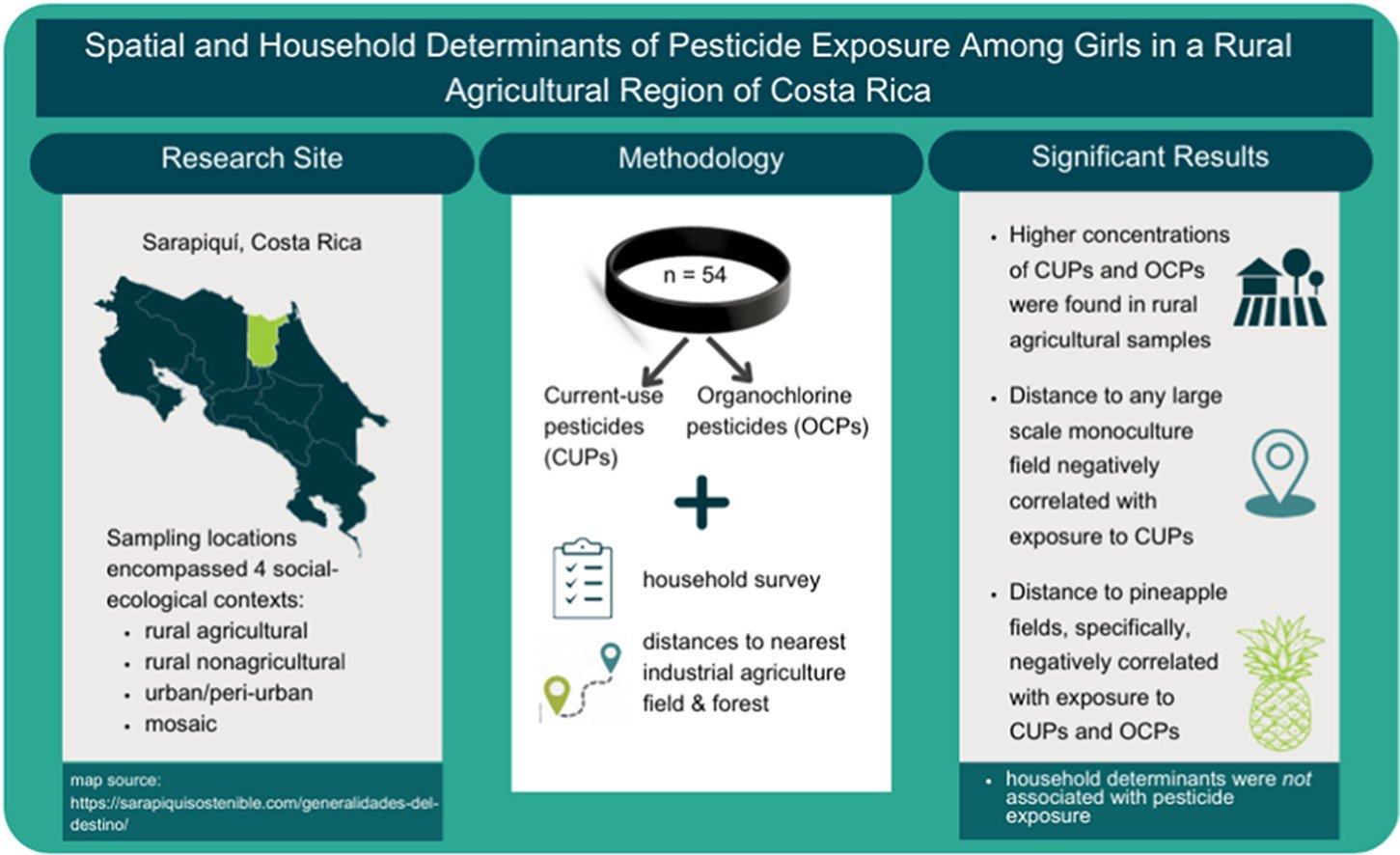
Pesticide exposure during childhood can disrupt endocrine and metabolic functions, increasing the risk of chronic diseases. Thus, it is important to understand the determinants of pesticide exposure among youth, especially in rural agricultural areas where individuals are more likely to be exposed due to the application of pesticides in nearby fields. Here we present novel data from the first investigation to use silicone wristbands to measure individual passive chemical exposure in Costa Rica. We evaluated the contributions of social-ecological context (SECs: rural agricultural, rural nonagricultural, urban/peri-urban, and mosaic), household factors (composition, occupation of household members, and income), perceptions of personal pesticide exposure, and distance to agricultural fields (general, pineapple, and banana) and forest to exposure to current-use pesticides (CUPs) and legacy organochlorine pesticides (OCPs) among a sample of girls from a rural agricultural region of Costa Rica. Wristbands were worn for an average of 4.5 days, and pesticide levels were analyzed using liquid/gas chromatography and mass spectrometry (LC/MS/MS). Higher pesticide concentrations were found in rural agricultural participants compared to those from urban/peri-urban and rural nonagricultural areas, with variation in exposure linked to proximity to large-scale monoculture and, particularly, pineapple plantations. By providing the first documentation of personal pesticide exposure among children and adolescents from Sarapiquí, we show that exposure to pesticides is not dependent on household factors but is connected to proximity to intensive pineapple agriculture. This suggests that pesticides applied to pineapple fields are not contained within the plantations.